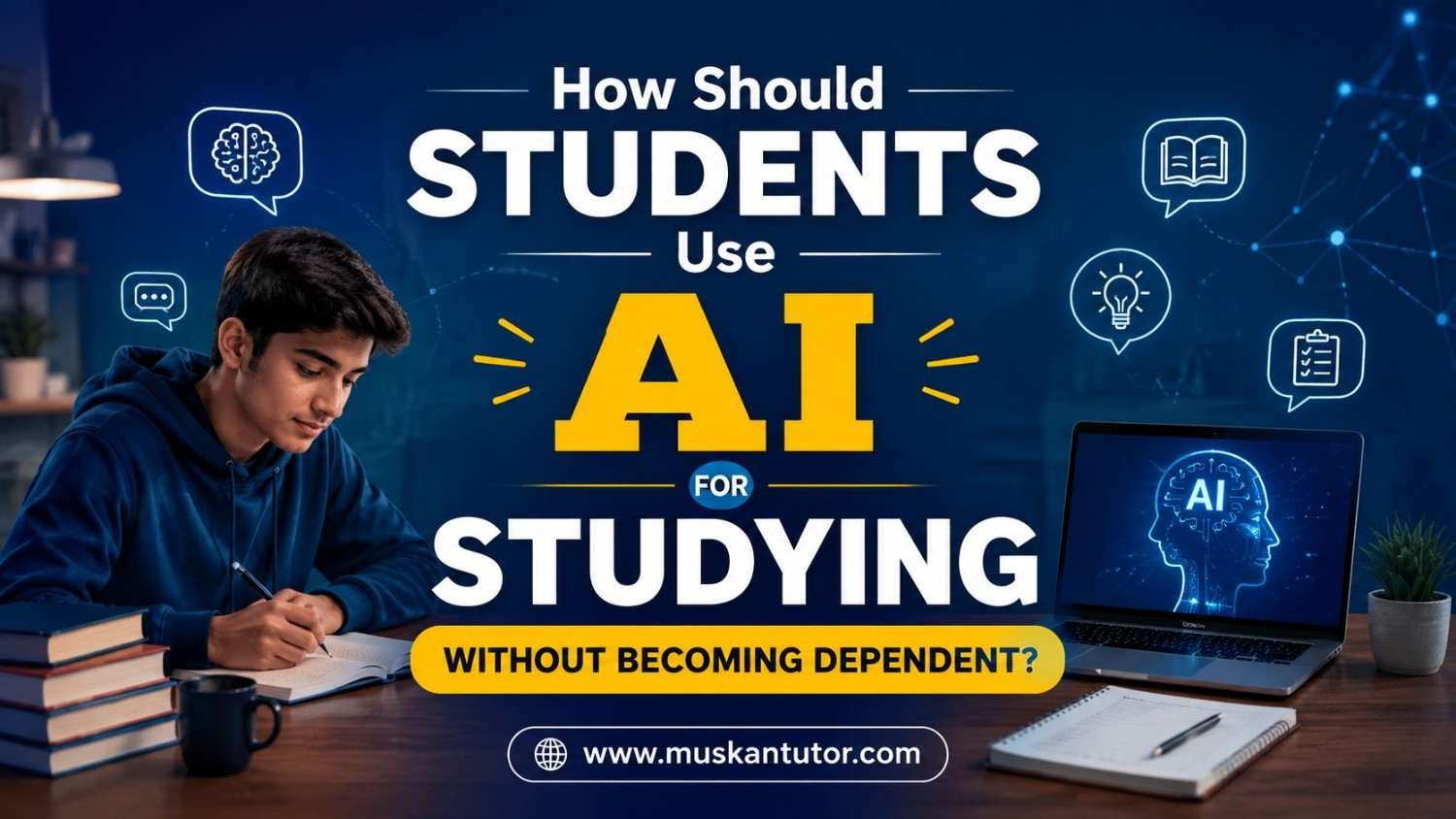
How Should Students Use AI for Studying Without Becoming Dependent?
Artificial intelligence is becoming an increasingly useful part of modern education. When students use AI for studying, it can help them understand difficult concepts, practice questions, organize their study schedules, and revise lessons more effectively. However, AI should support learning rather than replace a student’s own thinking. Understanding AI for students, following practical AI study tips, and learning how to use AI for studying responsibly can help students benefit from technology while continuing to develop independent learning skills.
What Is the Role of AI in Education?
Artificial intelligence can provide students with quick explanations, examples, practice exercises, summaries, and personalized learning support. Unlike traditional study methods, some AI learning tools can respond to a student’s specific question and explain a concept in different ways.
For example, a student who finds a mathematics topic difficult can ask AI to explain the basic concept step by step. A student studying English can use AI to practice grammar or improve vocabulary. Similarly, students studying science can ask for simple explanations of complicated concepts.
However, AI is not a replacement for teachers, textbooks, classroom learning, or independent practice. Students should consider it a supporting resource within a broader learning process.
Why Can Students Become Dependent on AI?
The biggest advantage of AI—providing quick answers—can also become a disadvantage if students use it incorrectly.
A student may become dependent on AI by:
- Asking AI to complete every homework assignment
- Copying answers without understanding them
- Using AI instead of reading textbooks
- Avoiding difficult problems because AI can solve them instantly
- Asking AI to write every essay or project
- Depending on AI for basic research and decision-making
- Accepting AI-generated information without checking it
When students consistently rely on ready-made answers, they may have fewer opportunities to develop problem-solving, critical-thinking, writing, and research skills.
The goal should therefore be effective AI learning, where technology makes studying better without removing the student’s responsibility to learn.
How Should Students Use AI for Studying?
1. Use AI as a Tutor, Not an Answer Machine
One of the best AI study tips is to ask AI to teach rather than simply provide answers.
Instead of asking:
“Solve this question for me.”
A student can ask:
“Explain the concept behind this question and give me hints so I can solve it myself.”
This approach encourages active learning. Students can attempt the problem first and then use AI to identify mistakes or understand the difficult steps.
2. Ask for Simple Explanations
AI can be particularly useful when a textbook explanation feels complicated.
Students can ask AI to explain a topic using simple language, examples, comparisons, or step-by-step explanations. After receiving the explanation, the student should close the AI tool and explain the concept independently.
This is an excellent way to check whether the topic has actually been understood.
3. Use AI to Create Practice Questions
Practice is essential for academic success. Students can use AI education tools to create quizzes, multiple-choice questions, short-answer questions, or revision exercises based on a particular topic.
For example, after studying a chapter, a student can request practice questions without answers. The student can attempt them independently and then use AI to review the responses.
This turns AI into a practice partner instead of a shortcut.
4. Use AI for Revision
AI can help students organize revision before examinations.
Students can ask for:
- Chapter summaries
- Important concepts
- Revision questions
- Flashcard ideas
- Practice quizzes
- Topic-based explanations
- Study schedules
However, students should compare AI-generated information with their textbooks, school notes, and teacher-provided material.
5. Always Think Before Accepting an AI Answer
One important lesson about students and artificial intelligence is that AI can sometimes provide incorrect, incomplete, or misleading information.
Students should develop the habit of asking:
- Is this answer correct?
- Does it match my textbook?
- Can I verify this information?
- Do I understand the explanation?
- Can I explain the answer without AI?
This develops critical-thinking skills and prevents students from blindly trusting technology.
6. Complete Assignments Independently
AI can provide guidance, but students should complete their academic work themselves whenever their school’s rules require independent work.
For example, AI can help a student understand how to structure an essay, but the student should develop their own ideas and writing. AI can explain a mathematics method, but the student should solve the assigned problems independently.
This distinction is essential for responsible AI use.
7. Combine AI With Human Teaching
Technology works best when combined with effective human guidance.
Teachers and tutors can understand a student’s learning difficulties, motivation, classroom behavior, and progress in ways that an AI tool cannot fully replicate.
A qualified home tutor can provide personalized explanations, monitor practice, identify weak areas, and encourage students to solve problems independently. Similarly, an online tutor can provide structured learning support from home.
For students studying different classes and subjects, combining traditional teaching with appropriate AI learning tools can create a balanced learning environment.
A Simple AI Study Method for Students
A useful AI study guide can follow the Learn → Practice → Check → Improve method.
Learn
Study the topic using your textbook, classroom notes, teacher, or tutor.
Practice
Attempt questions independently before asking AI for assistance.
Check
Use AI to review your reasoning, identify mistakes, or explain confusing concepts.
Improve
Correct your mistakes and attempt a similar question without AI.
This process ensures that AI supports the learning cycle rather than replacing it.
How Parents Can Encourage Healthy AI Use
Parents can help students develop responsible technology habits by creating clear expectations.
Instead of completely banning AI, parents can discuss when and how it should be used.
Useful guidelines include:
- Encourage independent homework attempts.
- Ask children to explain what they learned.
- Encourage textbook and teacher-based learning.
- Discuss the reliability of AI-generated information.
- Set appropriate screen and study routines.
- Encourage reading, writing, and problem-solving without technology.
- Teach children that AI is a tool, not a substitute for education.
The objective should be to develop confident learners who can use technology intelligently.
AI Should Support Learning, Not Replace Thinking
The future of education will likely include more artificial intelligence, but fundamental learning skills will remain important. Reading, writing, communication, mathematics, creativity, reasoning, and problem-solving cannot be developed effectively through simply copying AI-generated answers.
Students who learn how to use AI for studying responsibly can gain valuable advantages while maintaining their independence.
For students who need additional academic support, MuskanTutor provides home tutor and online tutor support for students across classes and subjects. Personalized teaching can complement digital learning by giving students structured guidance, regular practice, and individual attention.
Parents and students can contact MuskanTutor at +91 89205 80968 or email info@muskantutor.com to learn more about tutoring support.
Conclusion
AI can be a powerful educational resource when students use it thoughtfully. The best approach is not to avoid AI completely or depend on it for every task. Instead, students should use AI to understand difficult concepts, generate practice questions, review mistakes, organize revision, and explore subjects more effectively.
The most important rule is simple: use AI to help you learn, not to do the learning for you.
By combining AI learning tools with teachers, tutors, textbooks, independent practice, and critical thinking, students can prepare themselves for a future where technology and education work together.
Frequently Asked Questions
Is AI good for students?
Yes. AI can help students understand difficult topics, practice questions, revise lessons, and explore subjects. However, it should be used as a learning aid rather than a replacement for teachers or independent study.
How can students avoid becoming dependent on AI?
Students should attempt questions independently before using AI, ask for explanations instead of ready-made answers, verify information, and regularly complete reading, writing, and problem-solving activities without AI.
Can AI replace a home tutor?
AI can provide explanations and practice support, but it cannot fully replace personalized teaching. A home tutor can monitor progress, identify learning gaps, adapt teaching methods, and provide continuous human guidance.
Can students use AI for homework?
Students can use AI for learning support where permitted, such as understanding concepts or checking their work. They should follow their school’s academic-integrity rules and avoid submitting AI-generated work as their own when independent work is required.
What is the best way to use AI for studying?
A balanced approach is best: learn the topic independently, practice without AI, use AI when you need clarification, check your mistakes, and then solve similar problems independently. This encourages effective AI learning without creating dependency.