Class 12 ISC Physics Syllabus Chapter-Wise Explained
The Class 12 ISC Physics syllabus is designed to help students develop a strong understanding of fundamental physics concepts, numerical problem-solving techniques and scientific applications. Physics is an important subject for students preparing for ISC board examinations and competitive entrance exams. Understanding the physics syllabus class 12 ISC chapter by chapter helps students organise their study schedules, identify important topics and prepare more effectively. In this guide, we explain the ISC Class 12 Physics syllabus for 2026-27, its major chapters, preparation strategies and useful tips to improve examination performance.
Overview of the ISC Class 12 Physics Syllabus 2026-27
Physics in Class 12 introduces students to several important areas of science, including electricity, magnetism, optics, electromagnetic waves and modern physics. The curriculum focuses on theoretical knowledge as well as practical applications.
Students should understand the concepts, practise numerical questions regularly and revise important formulas throughout the academic year.
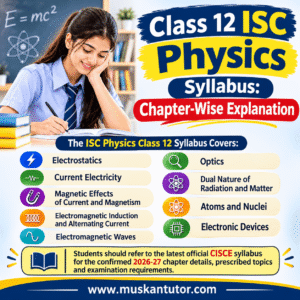
The ISC physics class 12 syllabus generally covers the following major areas:
- Electrostatics
- Current Electricity
- Magnetic Effects of Current and Magnetism
- Electromagnetic Induction and Alternating Current
- Electromagnetic Waves
- Optics
- Dual Nature of Radiation and Matter
- Atoms and Nuclei
- Electronic Devices
Students should refer to the latest official CISCE syllabus for the confirmed 2026-27 chapter details, prescribed topics and examination requirements.
Class 12 ISC Physics Syllabus: Chapter-Wise Explanation
Understanding the ISC Class 12 physics chapters individually makes preparation easier. Below is an overview of the major topics students should study.
1. Electrostatics
Electrostatics introduces students to electric charges and the forces between them. It builds the foundation for understanding electrical phenomena.
Important topics include:
- Electric charges and their properties
- Coulomb’s law
- Electric field and electric field lines
- Electric dipole
- Electric potential and potential difference
- Capacitance and capacitors
Students should practise numerical problems based on Coulomb’s law, electric fields and capacitance to strengthen their understanding.
2. Current Electricity
Current Electricity explains the movement of electric charges through conductors and the behaviour of electrical circuits.
Important topics include:
- Electric current and resistance
- Ohm’s law
- Resistivity and conductivity
- Combination of resistors
- Kirchhoff’s laws
- Electrical energy and power
- Cells and internal resistance
Numerical practice is especially important in this chapter because questions frequently involve circuit calculations and electrical relationships.
3. Magnetic Effects of Current and Magnetism
This chapter explains the relationship between electricity and magnetism. Students learn how moving charges and electric currents produce magnetic fields.
Important topics include:
- Magnetic field and magnetic field lines
- Biot-Savart law
- Ampere’s circuital law
- Force on a moving charge
- Force on a current-carrying conductor
- Torque on a current loop
- Magnetic properties of materials
Focus on understanding diagrams, mathematical relationships and the applications of magnetic principles.
4. Electromagnetic Induction and Alternating Current
This section introduces the concept of electromagnetic induction and explains how changing magnetic fields can generate electric currents.
Important topics include:
- Faraday’s laws of electromagnetic induction
- Lenz’s law
- Magnetic flux
- Self-induction and mutual induction
- Alternating current
- AC circuits
- Transformers
Students should understand the working principles of transformers and practise numerical questions involving alternating current.
5. Electromagnetic Waves
Electromagnetic waves are important for understanding how energy travels through space.
Important topics include:
- Displacement current
- Nature of electromagnetic waves
- Properties of electromagnetic waves
- Electromagnetic spectrum
- Applications of different electromagnetic waves
Students should learn the electromagnetic spectrum in the correct order and understand the practical applications of each type of wave.
6. Optics
Optics is an important area of the physics syllabus class 12 ISC. It explains the behaviour of light and its interaction with different materials.
Important topics include:
- Reflection and refraction of light
- Refraction through lenses
- Optical instruments
- Total internal reflection
- Wavefronts and Huygens’ principle
- Interference of light
- Diffraction and polarisation
Practising ray diagrams and numerical problems can help students understand this chapter more effectively.
7. Dual Nature of Radiation and Matter
This chapter introduces the concept that light and matter can exhibit both wave-like and particle-like behaviour.
Important topics include:
- Photoelectric effect
- Einstein’s photoelectric equation
- Wave-particle duality
- de Broglie wavelength
- Matter waves
Students should focus on understanding the photoelectric effect and practising related numerical questions.
8. Atoms and Nuclei
Atoms and Nuclei explain the structure of matter at the atomic and nuclear levels.
Important topics include:
- Rutherford’s atomic model
- Bohr’s atomic model
- Energy levels
- Atomic spectra
- Nuclear composition
- Radioactivity
- Nuclear fission and fusion
- Mass defect and binding energy
Understanding the basic theories and practising formula-based questions are important for this chapter.
9. Electronic Devices
Electronic Devices introduces students to the fundamentals of semiconductor technology and electronic components.
Important topics include:
- Energy bands in solids
- Conductors, insulators and semiconductors
- Intrinsic and extrinsic semiconductors
- Semiconductor diodes
- Rectifiers
- Applications of semiconductor devices
Students should focus on circuit diagrams, semiconductor properties and practical applications.
How to Prepare for the ISC Physics Examination
Preparing for board examinations requires consistency, proper planning and regular revision. Here are some useful strategies for students.
- Understand the Complete Syllabus
Start by reviewing the latest official ISC physics syllabus. Identify all prescribed chapters and topics before beginning your preparation.
- Create a Chapter-Wise Study Timetable
Divide your available study time among different chapters. Give additional attention to difficult topics and chapters that require more numerical practice.
- Practise Numerical Questions
Physics requires conceptual understanding and calculation skills. Solve textbook exercises, sample questions and previous examination papers regularly.
- Prepare a Formula Notebook
Maintain a separate notebook containing important formulas, definitions, laws and mathematical relationships. Revise it frequently.
- Focus on Practical Work
Do not ignore laboratory experiments and practical examinations. Understand experimental procedures, observations, diagrams and calculations.
- Take Regular Mock Tests
Attempt timed practice papers to improve speed, accuracy and time management. Review your mistakes after every test.
How MuskanTutor Can Help Students Prepare for ISC Physics
Preparing for Class 12 Physics can become challenging when students struggle with numerical problems, complex concepts or time management. Personalised guidance can make the learning process more organised and effective.
MuskanTutor provides home tutor and online tutor services for students of all classes and subjects. Students looking for individual academic support can connect with experienced tutors according to their learning requirements.
Benefits of learning with a personal tutor include:
- Individual attention and personalised learning plans.
- Chapter-wise explanations of difficult Physics concepts.
- Regular numerical practice and doubt-clearing sessions.
- Flexible home tuition and online tuition options.
- Support for school examinations and board preparation.
- Guidance in subjects including Mathematics, Science, English and Commerce.
Whether students need help understanding the ISC physics class 12 syllabus or want regular academic support, the right tutor can help them build confidence and improve their learning outcomes.
Conclusion
The ISC Class 12 Physics syllabus covers important concepts that develop students’ scientific understanding and problem-solving abilities. From Electrostatics and Current Electricity to Optics, Atoms and Nuclei, every chapter contributes to a strong foundation in Physics.
Students should follow the official syllabus, practise numerical questions, revise important formulas and solve sample papers regularly. With consistent preparation and appropriate academic guidance, students can approach their ISC board examinations with greater confidence.
Frequently Asked Questions (FAQs)
1. What are the main chapters in the Class 12 ISC Physics syllabus?
The major areas include Electrostatics, Current Electricity, Magnetism, Electromagnetic Induction, Electromagnetic Waves, Optics, Dual Nature of Radiation and Matter, Atoms and Nuclei, and Electronic Devices. Refer to the latest CISCE syllabus for the prescribed chapter details.
2. Is the ISC Class 12 Physics syllabus difficult?
The difficulty level depends on a student’s conceptual understanding and preparation. Chapters involving numerical calculations and complex concepts may require additional practice. Regular revision and problem-solving can make Physics easier to understand.
3. How can I prepare for the ISC Physics board examination?
Start by understanding the complete syllabus, preparing a chapter-wise timetable, practising numerical questions, revising formulas and solving previous examination papers. Regular mock tests can also improve performance.
4. How important are numerical questions in ISC Class 12 Physics?
Numerical questions are an important part of Physics preparation. Students should practise problems involving electricity, magnetism, optics and modern physics to improve their calculation skills and conceptual understanding.
5. Where can I find a home tutor for ISC Class 12 Physics?
Students can contact MuskanTutor for home tuition and online tuition services. MuskanTutor provides tutor assistance for different classes and subjects. Call +91 8920580968 or email info@muskantutor.com to enquire about available tutors.