Story Writing for Class 7 with Examples and Easy Format
Story writing for Class 7 is an important part of English learning that helps students improve their creativity, vocabulary, grammar, and communication skills. Through story writing in Class 7, students learn how to develop interesting characters, organize events, and create meaningful endings. Learning story writing with hints for Class 7, exploring interesting story writing topics for Class 7, and practising story writing questions for Class 7 can help students perform better in school examinations. In this guide, MuskanTutor explains the story writing format, provides easy examples, and shares useful tips to help students become confident writers.
What Is Story Writing?
Story writing is the process of creating a sequence of events involving characters, a setting, a problem, and a conclusion. A story can be based on imagination, personal experiences, moral lessons, or everyday situations.
For Class 7 students, a good story should be simple, interesting, grammatically correct, and easy to understand. It should have a clear beginning, middle, and ending. Students should also focus on the main idea rather than adding unnecessary details.
Story Writing Format for Class 7
Understanding the story writing format for Class 7 makes it easier to organize ideas and write a complete story. Follow these five steps:
1. Write an Interesting Title
Choose a short and meaningful title that reflects the main idea of your story. Examples include “The Honest Woodcutter,” “A Helpful Friend,” and “The Magic Pencil.”
2. Introduce the Characters and Setting
Begin by introducing the main characters and explaining where and when the story takes place. For example, your story might begin in a small village where a hardworking boy lives with his family.
3. Develop the Main Events
Describe the events that move the story forward. Introduce a problem, challenge, or surprising situation that makes readers interested in what happens next.
4. Write the Climax and Ending
Explain how the main problem is solved. The ending should connect naturally with the events of the story and provide a satisfying conclusion.
5. Add a Moral, If Required
Many school stories teach lessons about honesty, kindness, patience, courage, or hard work. Add a moral when the question asks for one or when it suits the story.
Class 7 Story Writing Examples
The following Class 7 story writing examples demonstrate how students can develop simple ideas into complete stories.
Example 1: The Honest Woodcutter
Once upon a time, there lived a poor woodcutter in a small village. Every day, he went to the forest to collect wood and earn money for his family.
One afternoon, while cutting a tree near a river, his axe slipped from his hand and fell into the deep water. The woodcutter became very sad because he could not afford to buy another axe.
Suddenly, a magical figure appeared and offered to help him. First, the figure showed him a golden axe. The woodcutter refused it because it was not his. Next, a silver axe was shown, but he refused that too. Finally, the figure brought his original iron axe.
The woodcutter happily accepted his axe. Impressed by his honesty, the figure rewarded him with all three axes.
The woodcutter returned home happily and continued to live an honest life.
Moral: Honesty is the best policy.
Example 2: A Friend in Need Is a Friend Indeed
Rohan and Aman were close friends who studied in the same class. They always helped each other with homework and school activities.
One day, Rohan forgot to bring his lunch to school. He felt hungry and worried because he had no money to buy food. Aman noticed his problem and immediately shared his lunch with him.
Rohan thanked Aman for his kindness. A few days later, Aman fell ill and missed school. Rohan visited him, shared the class notes, and helped him complete his homework.
Both friends understood that true friendship means supporting one another during difficult times.
Moral: A true friend always helps in times of need.
Story Writing with Hints for Class 7
Story writing with hints for Class 7 helps students turn a few words or clues into a complete and meaningful story. Read the hints carefully and arrange them in a logical sequence before writing.
Practice question: The Thirsty Crow
Hints: A hot summer day – a thirsty crow – searching for water – finds a pot – very little water – sees some pebbles – drops pebbles into the pot – water rises – drinks water – flies away happily.
Sample answer:
One hot summer day, a crow felt very thirsty. It flew from one place to another in search of water but could not find any. Finally, it saw a pot near a house. There was a little water at the bottom, but the crow could not reach it.
The crow noticed some pebbles lying nearby. It picked them up one by one and dropped them into the pot. Slowly, the water level rose. The crow drank the water and flew away happily.
Moral: Intelligence and patience can solve difficult problems.
Story Writing Topics for Class 7
Practising different subjects helps students develop imagination and learn how to write stories in various situations. Here are ten useful story writing topics for Class 7:
- The Day I Helped a Stranger
- A Visit to a Magical Forest
- The Importance of Honesty
- A Memorable Day at School
- The Boy Who Never Gave Up
- A Mysterious Box in My Garden
- The Value of Teamwork
- A Rainy Day Adventure
- The Clever Rabbit and the Lion
- How I Saved a Little Bird
Choose a topic you understand well. Before writing, note down the main characters, setting, problem, solution, and ending.
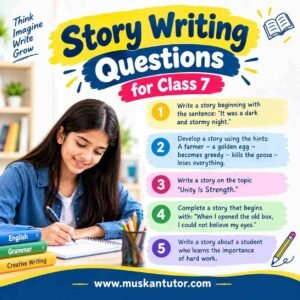
Story Writing Questions for Class 7
The following story writing questions for Class 7 can help students practise for classroom activities, homework, and English examinations.
- Write a story beginning with the sentence: “It was a dark and stormy night.”
- Develop a story using the hints: A farmer – a golden egg – becomes greedy – kills the goose – loses everything.
- Write a story on the topic “Unity Is Strength.”
- Complete a story that begins with: “When I opened the old box, I could not believe my eyes.”
- Write a story about a student who learns the importance of hard work.
Easy Story Writing Tips for Class 7
Follow these practical tips to improve your English writing:
- Plan before writing: Organize your ideas into a beginning, middle, and ending.
- Use simple English: Prefer clear sentences and age-appropriate vocabulary.
- Maintain the correct tense: Use past tense consistently when narrating past events.
- Use linking words: Words such as “suddenly,” “afterwards,” “meanwhile,” and “finally” make the story flow naturally.
- Check grammar and spelling: Review your work before submitting it.
- Practise regularly: Complete short story writing exercises for class 7 to build confidence and improve sentence formation.
Students should also read storybooks and observe how authors introduce characters, build suspense, and conclude their stories.
How MuskanTutor Can Help Class 7 Students
MuskanTutor provides home tutors and online tutors for students of all classes and subjects. Students who need support with English grammar, creative writing, comprehension, vocabulary, or school examination preparation can benefit from personalized learning.
Our tutors help students understand difficult concepts, practise writing assignments, improve grammar, and develop independent learning habits. Parents can explore suitable home tuition or online tuition options based on their child’s class, subject requirements, and learning needs.
For information about tutoring services, contact MuskanTutor using the details: Phone: +91 8920580968, Email: info@muskantutor.com.
Conclusion
Story writing for Class 7 becomes easier when students understand the correct format and practise regularly. By learning from examples, using hints, exploring different topics, and answering practice questions, students can improve their creativity and English writing skills. Focus on clear sentences, logical events, correct grammar, and meaningful conclusions to write effective stories.
With consistent practice and the right guidance, students can become more confident in creative writing and prepare better for school assignments and examinations. MuskanTutor can support students through personalized home tuition and online tutoring for English and other subjects.
Frequently Asked Questions
1. What is the correct story writing format for Class 7?
The basic format includes a title, introduction, main events, climax, and conclusion. Add a moral when required by the question.
2. How many words should a Class 7 story contain?
The expected length depends on the teacher’s instructions or examination question. If no word limit is given, write a complete story with a clear beginning, middle, and ending without unnecessary details.
3. How can students write a story using hints?
Read all the hints, arrange them in a logical order, and connect them using complete sentences. Add suitable details while keeping the original idea unchanged.
4. Which topics are best for story writing in Class 7?
Topics about friendship, honesty, kindness, school experiences, courage, teamwork, and imaginative adventures are suitable for Class 7 students.
5. How can students improve their English story writing skills?
Students can improve by reading regularly, learning new vocabulary, practising different story topics, checking grammar, and receiving feedback from teachers or tutors.